Tuesday, June 21, 2011

Notes from a trip to the Saatchi Gallery


Last week we had a trip to the Saatchi gallery. I’ve got to say I was a little disappointed, not with the work on show, but with the way it was exhibited. I don’t know, perhaps artists want their work to be displayed in cold, white, clinical box-like rooms, but I find it makes me feel uncomfortable and detracts from the experience of whatever piece I’m looking at. I find I can’t get involved in a piece in the same way. It’s hard to really take in a piece when you’re feeling self-conscious and exposed. But that’s a rant for another day.

Anyway, there were some really interesting pieces. The current exhibition is looking at contemporary sculpture, and there seems to be a bit of a trend towards viscerally unfinished-looking pieces, full of drips and raw edges. I’m putting a few notes and pictures of a few of the pieces that really struck me below. All of the pictures are ones I took myself on the day, the names of the artists are included above, with links to their pages on the Saatchi website. The pictures are purely to illustrate my notes, no copyright infringement is intended.


There’s something really disturbing about these. Carnage as sculpture. It reminds me of some of the darker aspects of human nature, the morbid curiosity that makes people stare at horrific car accidents as they drive by. Putting such horrific accidents in a gallery environment says something really interesting about that habit.


These are so visceral, particularly the darker red one. The dripping wax has a raw, gory feel to it that’s quite unsettling, but the architectural forms evoke urban landscapes.


Seeing such cartoony, exaggerated forms in three dimensions is interesting. To me it highlights the differences between reality and caricature. They focus on and exaggerate features that have been fetishised by male sculptors for centuries, which gives them a quirkily feminist edge. Plus, they’re really amusing!


The white eyes are really creepy! I love the unfinished foam, it looks as though it’s impaled the figures.


I like the way the copper sulphate seems to be growing across the models like some sort of alien mould. The models themselves look rather like the cut-out ones you can buy, which gives these pieces a subversive repurposed feel.


I like the hunched pose, it makes it seem as though the figure is bent under some incredible burden. The sketchily drawn-on expression emphasises this feeling. The unfinished quality of the drawing and the roughly formed plaster, give the piece a primordial feel, as though the figure has stepped out half-formed.


Another disturbing piece. The detail in the lower body and torso contrast with the vague, almost Lovecraftian quality of the mass that replaces the figure’s head. The pale colouring of the flesh tones gives it a sickly, dead quality. The way the chest has caved in adds a brittle quality, but there’s a flow to the tendrils that fall down between the arms. Really interesting piece.


An abstract figure made of fur and reflection. Really interesting use of texture. It seems sort of tactile (though obviously I didn’t touch it!). There are little bits of fool’s gold on the mirrored steps, which makes me think of a journey through life, drawn to things that are valueless and missing things that are importance.


 Another piece that can best be described as "visceral". A mixture of explicit sexuality and violent dismemberment (I love the details of the exposed spine, shattered heads and swirling innards!) but with pale, almost pastel colours and exposed plaster. I like how the treatment of the plaster reflects the violent energy of the scene, and how the figures are not quite human, with their wings, multiple arms and shattered bodies. They seem more like personifications of sexual energy than human figures.


I’m not normally much of a one for large pieces, but these definitely had an impact in real life. They tower over you at about one and a half times life size. The level of detail in the face and hands is amazing, and I like the combination of modern clothing with the traditional concept of the giant (complete with walking stick).

This reminds me of early Mediterranean figurines. In the Bronze Age, Cypriot potters made a lot of figurines of bulls that have a similar shape, though this is much larger and has a (deliberately) cruder finish. Apparently it's based on traditional figurines from Mali, it certainly has an earthy ethnic feel.

I love the use of negative space here. Though the construction is fairly simple, being able to see between the struts to the lights beyond gives a sense of complexity and depth.

Sunday, June 19, 2011

Interesting BBC documentary

The BBC are doing a new series that looks at attribution of works, possible fakeries and how one goes about proving a painting is by a famous painter. The first episode was on earlier today and it looked at a painting that may or may not be by Monet. In the process of trying to work out whether the painting is genuine, the programme goes into some detail about Monet's painting style and the techniques scientists and art historians can now use to examine works. It also highlights some rather unsavoury aspects of the attribution process.

You can see it on iPlayer via the link above.

Sunday, June 12, 2011

Reclaiming the "Before" Body - Portraits of womens' torsos

This is a interesting project by Clarity Haynes: a series of portraits of women's torsos intended to normalise the frankly normal bodies used in advertisements for cosmetic surgeries and diet plans.

Here's part of  her statement from the website:
 
"Historically, the painted portrait signifies prestige, beauty and social power.  I choose to portray women's real bodies, which are often invisible in this culture.

The face is our commonly recognized self – our “mask” of identity. Focusing exclusively on the torso shines a light on a part of the individual that is usually hidden. Each torso bears traces of unique personal experience: tattoos, childbirth, aging, stretchmarks and surgical interventions.
...
The sitter's choice to have a portrait done is a courageous act of self-revelation. Portraiture involves participation, collaboration and even performance."

 Apparently Haynes has now produced over 500 of these "breast portraits", although only a small selection are shown on the website (there are also a selection of photographs of the models with their finished portrait and short statements about the process, which are interesting). 

Contemporary Portraiture

In my last post on portraiture I was focusing rather on ancient and historic portraiture, this time I'm going to look at some contemporary (or at least 20th century and onwards) artists' work.

Lucian Freud
Freud was born in Berlin in 1922, the grandson of the famous neurologist Sigmund Freud and the brother of the late writer and politician Clement Freud. The family moved to England in the 1930s to escape the rise of the Nazi party. Lucian studied at Goldsmith's College UCL and began working as an artist in 1943, when he was comissioned to produce a series of illustrations for a book of poems by Nicholas Moore. His early work tended towards surrealism, with curious juxtapositions of plants and animals, but in the 1950s his style changed into what he is now famous for: expressive but realistic depictions of people, often nudes. In the 1970s he became involved with a group of artists, later called the "School of London", including Francis Bacon who painted several portraits of Freud.

Freud's later work is typified by portraits and nudes. He uses thick impasto and muted colours, and is famous for his penetrating psychological depictions of his sitters, who are frequently family members and close friends. His unusually frank depictions of his sitters had made him a very contraversial figure. Some critics despise him, while newspapers are suspicious of his motives, particularly in the case of his paintings of Sue Tilley, such as Benefits Supervisor Sleeping (below)
Painted in 1995, the painting was sold for a record price in 2008, bringing it huge media attention. It is typical of Freud's style. A varied selection of flesh tones applied heavily gives the impression of uneven skin tone, cellutie and scars. We look down on the couch, giving it a distorted feel, and creating the uncomfortable feeling that the viewer has happened upon the sleeping figure. Her face seems contorted, as though troubled in dreams, but her pose seems comfortable, with her legs tucked beneath her and one arm bracing herself against the couch. Some critics have seen the painting as a cruel attack on obsetity, but I think it's more an attack on society's views on body image; the frankness in the detailing and the intimacy of the pose pull us closer to the model than some would like.

Interestingly, despite attacks on Freud's attitude to the sitter, the sitter herself seems very pleased and very comfortable with the painting as you can see from interviews such as this and this.

Some more examples of Freud's paintings can be seen here.

Francis Bacon
Bacon was born in Dublin in 1909 to English parents, but the family moved to London at the outbreak of the First World War. Prone to allergies and asthma, Bacon recieved very little schooling. While traveling in Europe, he visited an exhibition of Picasso's paintings and decided he would like to become a painter himself. On returning to London, he worked as an interior designer for a while, making sketches and entering competitions (when he tried to submit work for a surrealist show but was told his piece was "insufficiently surreal), before finally capturing public attention with his Three Studies for Figures at the Base of a Crucifixion (1944). He became well known for his disturbing, deformed take on figurative painting and continued to produce challegning works until his death in 1992. For more about his life and his attitudes to his work, here's an excellent edition of the South Bank Show from 1985, with some very interesting interviews with him.
 (source)
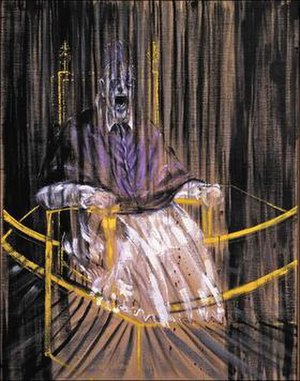
Bacon produced many unusual portraits. He believed that deconstructing a sitter's physical form was the only way to capture their true character. In an age when photography could capture how things appear, Bacon beleived that painting should capture deeper meaning. He also liked to work from pieces from history (if you watch the South Bank Show episode, you'll note he talks a lot about ancient work (such as Egyptian art and Greek plays) and the "masters") as can be seen in his portrait based on the life mask of William Blake and his Study after Velazquez's Portrait of Pope Innocent X:
 (source)

 Bacon produced many different studies for this piece, using largely the same colour pallette (purples, greys, blacks and yellow) and similarly extreme (often screaming) facial expressions (for more on some of these other studies, see Francis Bacon: The Papal Portraits of 1953 published by the Museum of Contemporary Art, San Diego). These studies are often considered portraits in their own right, although they cannot really be said to be portraits of Pope Innocent in the classic sense. These are portraits of a particular emotion, more than the subject of Velazquez's painting. Drawing in elements from photographs of distorted figures, film stills and animal studies, Bacon created paintings that seem immediate, human and yet deformed.


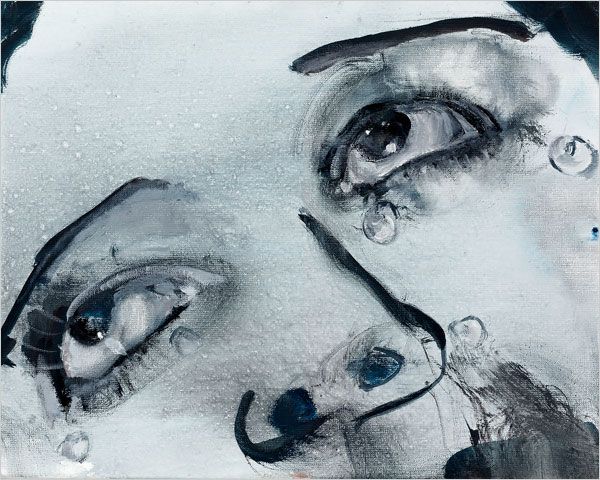
Marlene Dumas was born in South Africa in 1953 and studied Fine Art at the University of Cape Town. She then went on to study at the Psychological Institute of Amsterdam in the Netherlands, where she now lives and works as both an artist and lecturer. Her work, which focuses largely on figures and portraits, has strong psychologial and sexual themes, drawing eroticism and powerful emotions from simple, expressive paintings, as you can see from this selection and analysis from the Saatchi Gallery. She works exclusively from photographs, sometimes including photographs of herself, and often using muted tones and shades of greys, with occassional paintings in brighter tones.

Thematically, she often draws on contraversial subjects. In 1996 she satirised the beauty industry with an installation entitled Miss World Her 2006 installation Man Kind looked at global terrorism and mistaken identity, and she regularly deals with religion, racism and explicit sexuality.
There's a video here in which Marlene talks about her 2009 retrospective Measuring Your Own Grave. She mentions that she achieves some of her interesting colours through simply not cleaning her brushes.

Another video is here.

Guy Denning was born in England in 1965, but now lives and works in France. He was a founding member of the Bristol Stuckists group and founded the Neomodern movement in 1997. He frequently uses mixed media in his work, combining stencilled letters with impasto oils, spray paint and cuttings from newspapers and magazines, and he often uses unusually shaped supports created by joining several canvases. The result is work that is expressive and fraught with a sort of vicious physicality. His work is confrontational and highly political.

Here he is talking about his 2011 show in at the Red Propeller Gallery in Knightsbridge.
And here's footage of him painting works for his 2008 exhibition Celebrity will eat itself
And there are lots more interviews and videos of him at work on his youtube channel.
He also posts drawings on his blog.


Nolasco is not a particularly well known painter, but I stumbled across his work while researching this project and I was really struck by it. Nolasco is a Fillipino-American artist, born in New York in 1976 and studied at California State University. He now lives and works in California as both a painter and a location photographer for film, television and print.

His work combines text, wash and line drawing to create bright, engaging portraits and figurative studies.

Monday, June 6, 2011

Switzerland

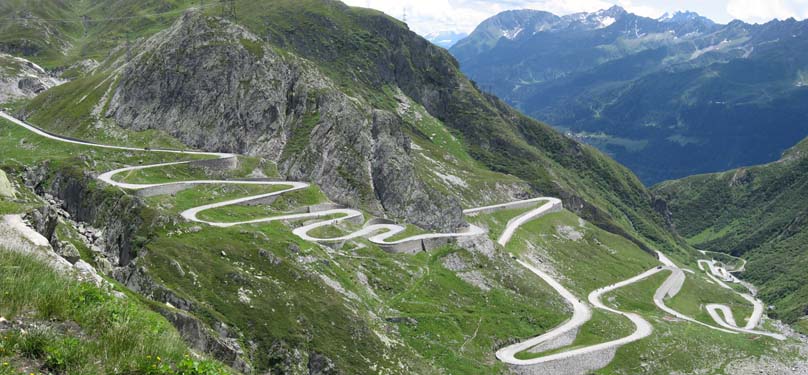
For my final piece, my sitter is Luna who comes from Switzerland. Her nationality is a big part of her identity so I'm planning on including a bit of a Swiss landscape in the background of the portrait (I'm hoping to go for a slightly stylised, dream-like quality to suggest memories, but we'll see how that comes out). In order to do that, I needed to make a few sketches.

Source for original
Original:
Source

Original

Source


Original
Source

Out and About

Over the last few months I've been busy with work so I haven't had time to sketch as much as I'd like. What I have had time for is a selection of strange, slightly stylised doodles of people. Since I'm working on the portrait project, doodles of people are almost connected...

People on the bus
These were a conscious decision to move away from my usual style of doodle into something more caricature-like, emphasising features. I also spent more time than usual on shading. Sometimes the proportions went a little...interesting (like the neck on the first one below, which is way to long even for a caricature) but overall I think these were okay given the amount of time I spent on them.


People at a nightclub
These doodly-sketches are in my usual default style for doodling and drawing things fast, partly because I drew most of them in under a minute each. Some of them I added details to later. I drew a lot more of these, but these are the best (ie the ones that look most like the "models"). And thanks very much to the kind people who let me draw them (badly).


Saturday, June 4, 2011

A Brief History of Portraiture

So, the next project is a portrait, and what better way to introduce the topic than to have a look at the genre's long, complicated history. Yes this is going to be another long post. And yes it's going to start far earlier than the syllabus allows for, because I believe in looking at the beginnings of things!


Portraiture is a specific form of representational artwork, usually a painting or sculpture, characterised by a recognisable depiction of an individual. “Recognisable” is the operative word here; a depiction of a person that does not show any distinguishing features or traits or one that is constructed from a formula is not usually considered a portrait.

Arguably the earliest portraits appear in ancient Egypt, though humans have drawn faces since prehistory. Though it was usual to draw individuals according to formula, distinguishable only by name labels or quirks in costuming and size, in some periods this idealised formula was altered significantly enough for individuals to be recognisable. Statues were particularly important to the Egyptians, both politically as ways for pharaohs and dignitaries to reinforce their position and religiously as an immortal and impenetrable vessel for the soul. Sesostris III of the Twelfth Dynasty (who ruled between about 1879BC and 1839BC) is unusual in that he was always depicted as a fairly old man, with deep-set, heavy-lidded eyes; gaunt cheeks and a slightly down-turned mouth. Sesostris came to power late in life and had a particularly difficult reign, so it seems his statues were designed to reflect this. When compared to images of his father, the difference is clear. Interestingly Sesostris’ son, Amenemhat III is depicted similarly in statuary during his own reign. It is not clear whether Amenemhat shared his father’s physical traits or was simply reinforcing himself as the son of such a powerful and popular pharaoh.
 Image from Wikipedia: Three statues of Sesostris III from the British Museum

In the Egyptian period we also see portraits taking on the roles they would continue to serve for millennia to come: in a world were literacy was uncommon even among the rich, portraits were a way for rulers and the elite to communicate with the public. A good example of this comes in the Eighteenth Dynasty with the reign of the notorious Akhenaten (best known today as the father of Tutankhamun). Akhenaten founded the first monotheistic religion, destroying many of the earlier polytheist sanctuaries and moving his palace to Amarna. To visually illustrate this change, Akhenaten employed artists (Bek, sculptor of the great Amarna temple, and Tutmose, sculptor of the famous bust of Nefertiti, Akhenaten’s chief wife) to create an entirely new way of depicting people. Akhenaten’s religion and the Amarna art style did not last, however, and though an Amarna influence can be seen in the tomb decoration of Tutankhamun both art and religion reverted back.

 Image from Wikipedia: In Amarna art, figures are depicted with elongated heads, long necks, drooping bellies and long thighs. There is some debate as to whether or not Akhenaten and his family really looked like this, some mummified remains seem to suggest that they had some form of genetic disorder. It doesn't really matter whether or not they looked like this, the change has a clear political message: the family are different to their predecessors.

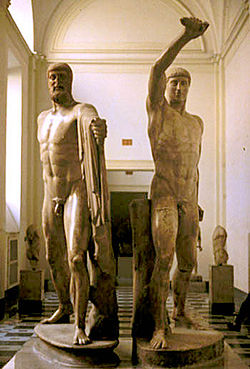
Portraiture in Greece took a lot longer to start showing signs of individualism. In the archaic period (contemporary with New Kingdom Egypt) depictions of people followed a formula very similar to Egyptian statues (in styles called kouroi and korai) but adding a smile to give a sense of the statue’s “soul”. Naturalism starts to appear in the early classical period but although figures start to look like real people they are not representations of real individuals. More often, statues are designed to depict gods and mythological figures, so though they may be realistic copies of the models used they were not intended to represent these models. However, we do start to see statues that were intended to depict real people (even if those people were long dead). The Tyrannicides monument commemorated Harmodius and Ariestogeiton, two lovers who killed a tyrant, and though it was rebuilt after the original statue was stolen by the Persians over fifty years after the pair were put to death, it is significant in being a fairly naturalistic depiction of two individuals.
 Image from Wikipedia: The Tyrannicides monument. Notice how the detailing in the face and hair suggests the different ages of the two figures. However, notice the stance with one leg put forward, still typically archaic in the kouros form.


As the classical period went on, “portraits” of historical figures became more common, such as this one of Athenian statesman Pericles or this one of the philosopher Socrates. (As an aside, most of these statues as they survive are Roman marble copies of the bronze originals, which were probably melted down. We do not know how accurate these copies were, and in many cases changes to the composition were made to support the marble where they would not be necessary in bronze). Portraits of living individuals are fairly rare, presumably it would have been considered hubristic. Even in funerary art portraiture is rare, it was far more common to decorate a tomb with mythological figures, simple pottery or formulaic made-to-order slabs depending on the time period.

Augustus as a conquering hero wearing armour covered in symbolism; images of Caligula with Alexander the Great’s hairstyle and a solar crown, and images of Hadrian with a Greek-style beard to show his love of Greek culture. Imperial sculpture was carefully moderated; state-approved statues would be made and then copies would be made of these to take to towns and cities around the empire. This method ensured the image the emperor wanted would be the one his subjects saw. It also means we have a very clear idea of what the emperor really looked like; mistakes are less common and each individual becomes clearly recognisable, if idealised.

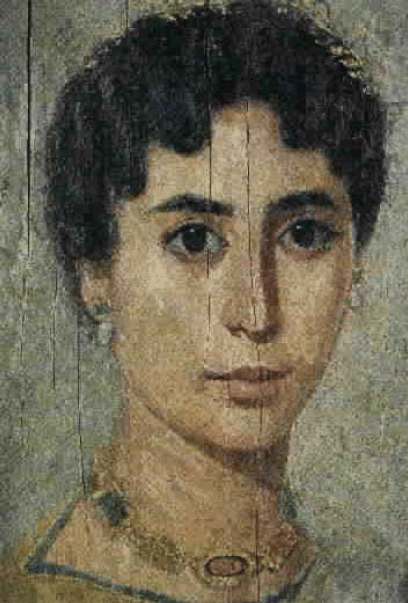
But portraiture also becomes more accessible for the upper (and perhaps even middle) classes of the Roman period too. The house of Lucius Caecillius Secundus, a wealthy banker, in Pompeii contains portraits of its owner, for example. In the Fayum district of Egypt, a series of fascinating painted death-mask portraits were found in the tombs of wealthy individuals. These are particularly interesting as paintings from this period are very rare. These paintings seem to have been commissioned by type but are remarkably naturalistic and show clear signs of individuality, not only in dress but in facial features too.

 Image via. One of the beautiful, if idealised, Fayum portraits, painted with surprising naturalism. From her hairstyle and gemmed necklace we can see that she was a wealthy woman.

In the medieval period, portraits become far more generalised and so probably can’t really be called “portraits” at all. Figures are drawn by formula and, like Egyptian paintings, often only identifiable by written labels. It was only the rediscovery of classical styles in the Renaissance that returned portraiture to the levels of individualism and detail of the Roman period. In the Renaissance, painting was the primary form of portraiture and, moving away from the generalised forms of the Middle Ages, there was now an increased emphasis on capturing the distinguishing features of the individual. However, like the art of ancient times, symbolism was still a key part of portraiture, as this painting of Elizabeth I shows. Painted to commemorate her victory over the Spanish Armada, it shows the battle occurring through a window behind her and she wears an extravagant dress covered with pearls to reinforce the image of her as ruler of the seas. The level of symbolism is enormous and leads to a slightly fantastical feel for modern viewers. For example, this engraving shows Henry VIII and his wife Jane Seymour standing before Henry VII and Elizabeth of York, both of whom were long dead by the time Henry VIII married Jane. Also, although there was an increased emphasis on capturing the sitter’s likeness, some artists were clearly more skilled than others (as the varying depictions of Henry VIII show) and artistic license proved problematic in a time when painting was the primary visual medium: Henry VIII famously fell for Anne of Cleaves based on a flattering portrait by Hans Holbein which was unfortunately quite unlike Anne herself.

Image via the Wikipedia link above. The unfortunate Anne of Cleves as painted by Holbein.


By the 17th century, the preferred style of painting was lighter and more naturalistic, with heavy emphasis on costume and hair. Early in the century the Tudor influence is clear in costuming if not in the treatment of the face itself (look at this painting of Elizabeth of Bohemia, notice the contrast between the treatment of the skin and the treatment of the dress) but around the time of the English Civil War, the overall treatment of the portrait becomes more unified. Clothing becomes a little simpler, in keeping with the views of the Republican government, and symbolism starts to give way in favour of settings that reflect the sitter’s character and interests. For example, this painting of the Royalist supporter Lord Capel and his family. The composition mirrors a painting of the King’s family, fitting as Capel was a Royalist, and shows the family’s garden through a window; Capel’s daughters Mary and Elizabeth were a distinguished horticulturalist and botanical painter respectively, while his son Henry helped to establish Kew Gardens. As the century wore on, extravagant fashions meant that more focus was put on clothing and hair than before (as can be seen in this painting of Charles II) but effort was still made to ensure the sitter’s character showed through.

In the eighteenth century naturalism and detail continued to be important. Naturalism can be seen not only in the style of painting but also in the poses and settings chosen for the sitters and detail is sought out in extravagant clothing and muted backgrounds, such as this painting of George III.  There is also an increasing tendency to depict the sitter at work or at play, so portraits with musical instruments (such as this or this) become common, as do self portraits of artists at work (such as this one or this). There's a frivolity and playfulness about these paintings.

In the nineteenth century the purpose of the portrait was changing. Changing attitudes to schools lead to increased literacy meaning portraits no longer had to take the place of text. Increased literacy and use of printing presses meant culture was changing too, making “celebrities” of writers like Charles Dickens, and increasing the public appetite for cartoons and caricatures (like this one. Caricatures had been popular since the 17th century, but it's only with increased literacy and readily available printing in the 19th that they really take off). The invention of photography changed matters further. Painting was no longer the most accurate form of representation, and though it started as something of a side-show amusement, it took off among the middle and upper classes after Queen Victoria and Prince Albert, who was very keen on new technology, were photographed. Photographers drew on the compositional skills of painters and incorporated details that were in keeping with the traditions of the portrait, such as this photograph of Dickens with his writing materials, or this photograph of Brunel. As a result, portrait painters began to experiment with more techniques that gave a more stylised appearance, as can be seen here and here.

In the 20th century these trends continued. Though naturalistic portraits were still produced, stylised work is more common. Photographic portraits became increasingly sharper and more defined. The purpose of portraiture has changed further. Advances in technology made photography far quicker and more accessible, meaning pictures of ordinary people are far more common and, often, more informal. Fine art photography, by contrast, has become almost as stylised as painting. Many photographers returned to black and white to create sharp, hyper-real portraits of their subjects.

Today there are many different styles and genres of portraiture, as advances in technology and changes in social structure have meant that the formal, symbolic portraits of previous centuries are no longer current. Even state and political portraits have changed significantly, just look at this comparatively informal photograph of Elizabeth II or Barack Obama’s “hope” campaign. 

 Image via. Shepherd Fairey's iconic poster (this version now in the Smithsonian) shows a very modern take on the traditional political portrait. Just like portraits from ancient times, it makes use of both symbolism, naturalism and a stylised style to present an idealised and instantly-recognisable image of its subject. However, unlike portraits from ancient and historic times, this portrait was not commissioned by the "sitter" but was created by the artist from a photograph.